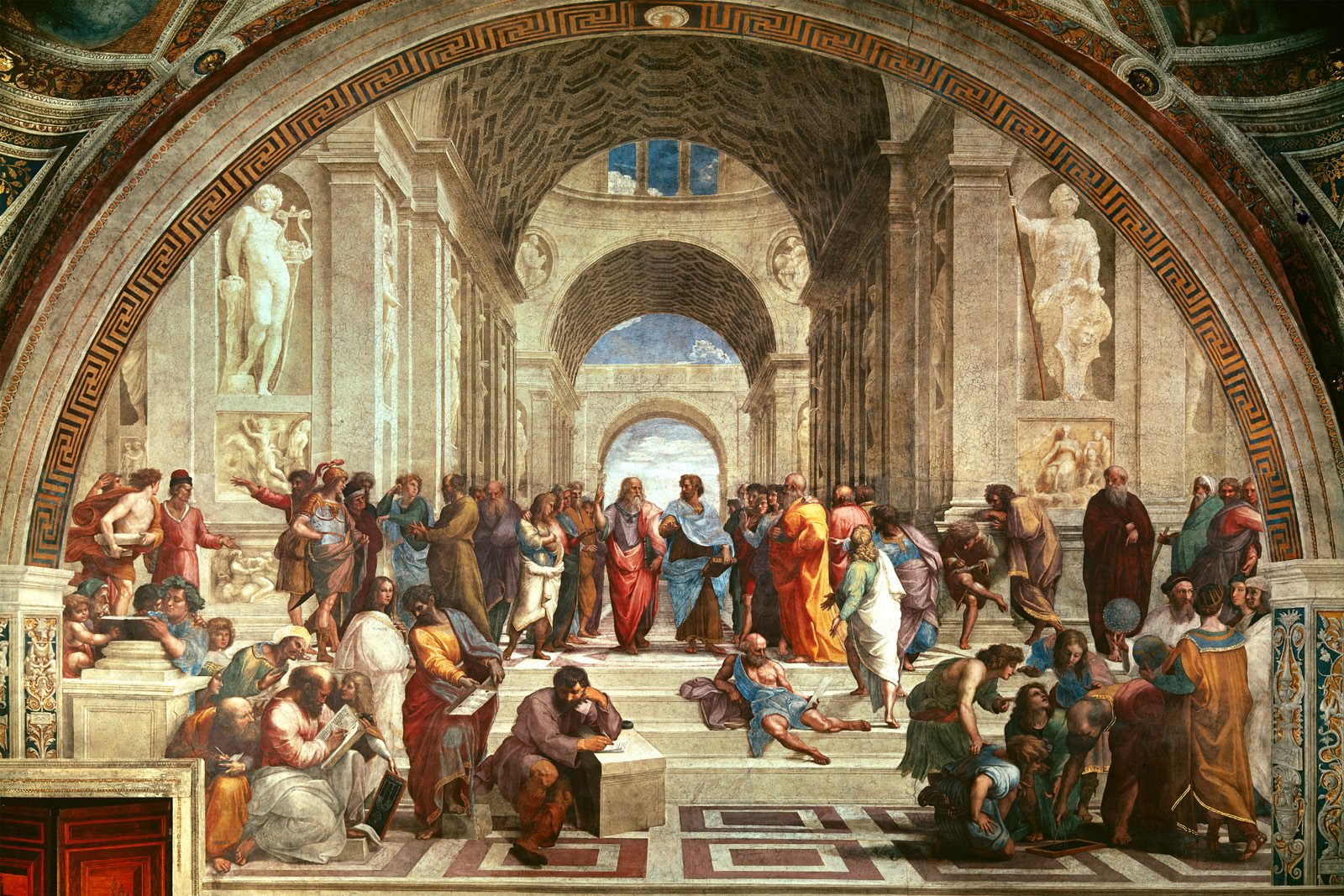
Modern people, including myself, have been tempted to look back at thinkers like Plato as if they were so charmingly confused it’s almost a burden we have to put up with an intellectual culture that historically took them serious.
It sounds insane to a modern person that Plato believed in pre-existent “Ideas” of which all the physical things of the world are but shades.
But this idea becomes less absurd when you realize that Plato ultimately was talking in part about the very undeniably real world of perception and consciousness and the nous.
The English word “idea” does indeed come from the Greek word Plato used, but has a very different meaning. In English, “idea” is similar to “concept,” but it certainly has no general or perceptual meaning. In Greek however, the word “idea” (ἰδέα) literally comes from the word for “see” and by its natural interpretation means something more like appearance or form.
After all, the defining characteristic of later western and post-Schism philosophy, as opposed to Orthodox theology is the gradual loss of the concept of nous whose original meaning is very close to and related consciousness. Consciousness is where the soul and body meet.
But it is better to associate the Greek concept of “idea” (ἰδέα) not with the modern English concept of idea, but with the very modern English concept of the quale. Qualia, in a way many have overlooked, are very closely analogous to ideas in this classical sense.
A Blue World

For example, suppose we live in a Blue World.
In this Blue World, we have a blue house, drive a blue car, etc. Everything is some shade of blue or at least something similar. In every other respect, it is the same as our universe, except for everything always has been blue.
Here’s a question: Does red exist in this universe?
No red objects exist. No one has ever seen or experienced red. Nonetheless, there is a sense in which red (the quale that would appear in our cognitive theater if we did see something red) does indeed exist. It has certain traits and a certain appearance that is set without anyone knowing about it or ever experiencing it. It certainly doesn’t pop into existence by our perception of it.
To be clear, I am talking about “red” as a quale, as we perceive it, not “red” to mean “red light” in an objective sense as a light of a certain wavelength. That would be an object in the universe, but it is not the same as the perceptual experience of the quale red. (One can exist without the other.)
We laugh at Plato’s forms, but in a sense, all of our qualia (that is the philosophical/psychological term for it) must have their properties before we perceive them. They exist without us perceiving them… In fact, they exist without us.
In fact, it is not just red that has an independent existence, but every quale (however they are divided). The existence of redness, bitterness, beauty, pain, etc. exist even if we do not perceive them. There is some independent and constant quality of each not relevant to whether a person perceives them.
It’s wrong to think that “red” is some physical object out there, but not just the logical structure of “red,” but its qualitative experience is something that is non-reduceable and independent of the observer.
More than that, even if our brains or perceptual apparatus are different—for example, suppose a person, as the mind experiment goes, perceives the things we see as blue as red and the things we see as red as blue. This is still little relevant—the qualitative perceptions are still something apart from the wavelengths of light, in fact, this example is really proof thereof. Red is not just the name we give certain objects of light of a certain wavelength. It actually is some qualitative experience we can perceive.
It is not a physical object. It is not an object in our mind. It is independent of our mind. It is a Platonic object, a Platonic form or idea (ἰδέα).
The Opposite: Nominalism

Philosophical nominalism, which became the norm in the post-Schism west, is the opposite idea that there are no forms or even true abstract entities. There is just matter, and some agglomorations of matter that our minds process and understand in a way that it makes up a common name (Lat. nomen) for them.
This can only come from an intellectual environment that omits from study the conscious world, where Platonic ideas or qualia are important explananda. If you are only talking about the unconscious world, it’s much easier to have a model of reality like nominalism that almost excludes the possibility of subjective conscious experience.
In nominalism, there is no form/ἰδέα “idea” of a chair behind actually existing chairs—nor even is there such a thing as “a human” as an abstraction. We are all slightly similar agglomorations of matter, which our mind only calls by the name “human” because they seem similar.
This highly analytical theory makes sense for talking about of objects in the universe, but is dysfunctional in the realm of the nous and consciousness.
Firstly, we only truly perceive qualia, and see objects as synthetic entities: if anything, we see wholes which our mind needs to break down for more detail, rather than seeing details that our mind needs to put together for a larger perception. We often forget that our perception is exactly the opposite of how a computer program might read information.
Imagine a computer reading an image file before even having a pixel of specific data, being able to say, “Oh, this is an image of a face.” and only then going on to notice the details. This is how the conscious mind works. You might argue that the brain somehow subconsciously assembles the “pixels” of our sensory input and presents to our mind a simplified quale of what we perceive—I’m not actually even sure that is what is happening, and most thinkers of antiquity did not think so—but even if that were true, it makes no efforts to craft a theory of the origin and nature of those qualitative experiences. Nominalism only dryly sidesteps trying to explain them by focusing on the arbitrary use of vocabulary to describe them.
A Little Synthesis

Of course modern proponents of nominalism (even if they don’t know the name and are only proponents implicitly) like nominalism because it seems to sidestep many philosophical problems. Exactly how many grains of sand makes a heap? To a nominalist, that is not really a philosophical problem, but perhaps a psychological one, and thus not so important.
But the “psychological” problem is really an even deeper philosophical problem: Why do certain wavelengths of light bring qualitatively different experiences? And what point does a person have a qualitatively different perception of the significance of an accumulation of sand?
I used the example above that a nominalist does not believe in the Platonic form of a “chair.” One alleged theoretical weakness of clumsy Platonism as William of Ockham and other nominalists criticized it is that it assumes that there must be inherent forms of everything, including invented devices, which exist independently.
Now I’m not going to tell people to read St. Maximus the Confessor on this, but that is an interesting idea. What I will say is that the Platonic thinking is much better calibrated to the world of qualia, and even if “chair” is not an independently existent form or even quale, in a sense it is a quale that is logically composed of other independent quale.
While I don’t necessarily think that Plato’s forms are perfectly in line with the modern concept of qualia, I do think he had something quite similar in mind, and even more, I suspect a serious rereadings of some classical texts of his and others will yield intuitions that shed more light on how earlier philosophy and religion viewed consciousness as a fundamental substance of the universe.